
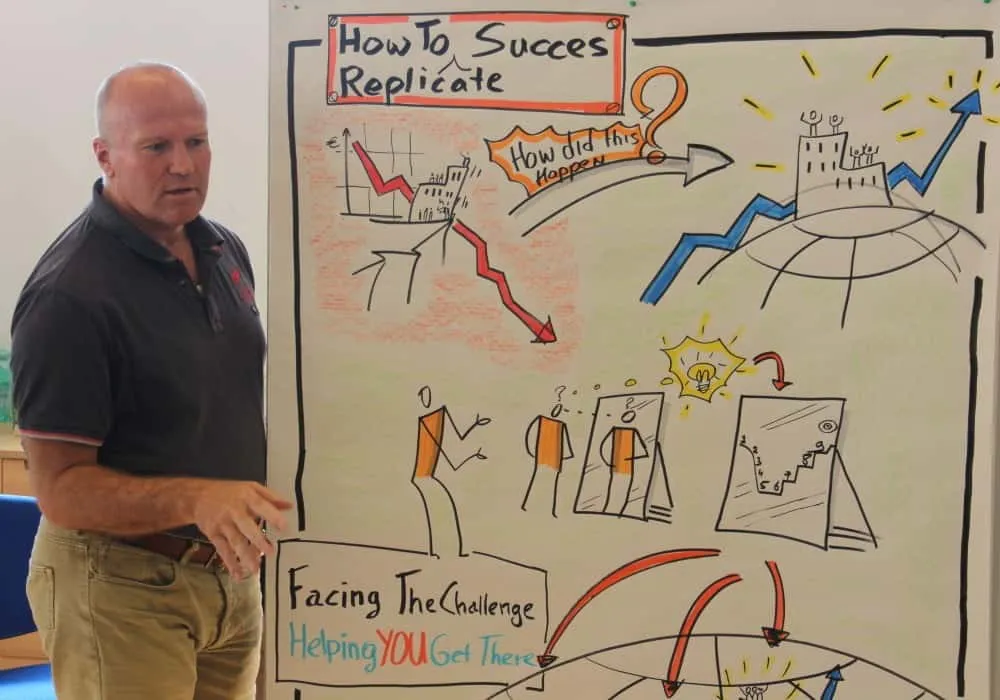
Robert Feddes
Leadership Output Acceleration · Founder, Facing The Challenge
For 30 years I've been doing one thing: helping leaders close the gap between what their organization can deliver and what it actually delivers.
I've worked with Leaders at Philips, IKEA, T-Mobile, and founders scaling from 50 to 1,500 people. The pattern is always the same. Capable leaders. Strong people. Output that doesn't match potential.
The reason is never talent. It's structural friction — invisible patterns of decision drag, misallocated authority, and assumed ownership that consume leadership capacity without producing proportional results.
I make those patterns visible. Then I help you remove them.
30+
Years in the field
1000+
Leaders served
€21M
Largest client savings
#1
Global position achieved
I didn't set out to build a methodology. I set out to answer one question.
Early in my career, I noticed something that didn't make sense. Organizations with strong leaders and capable people were consistently underperforming relative to their potential. Not because anyone was doing a bad job — but because something invisible was consuming capacity.
I started mapping it. Using psychometric tools to understand leadership configuration. Using operational frameworks to measure where output leaked. Working alongside leaders in the room, on the floor, in the actual mess of running organizations.
Over 20+ years with one particular leader — a man who took his organization from near-bankruptcy to #1 worldwide — I finally cracked the pattern. What made leaders successful was also creating a structural ceiling. The strengths that got them to the top were often quietly creating dependency, escalation, and output drag.
The question was never "How do we develop better leaders?" It was "How do we remove the invisible friction that prevents capable leaders from producing what they're actually capable of?"
That question became Facing The Challenge. A focused leadership development operation that measures leadership friction across four dimensions — Bottleneck, Silos, Fixing, and Playbook — and removes it. Fast.
The tools I use are the best in the world at what they do. The psychometric lens is the most widely used globally. The coaching methodology has the strongest track record in executive development. The operational execution framework turns your own people into the best internal consultants you could hire.
But none of that matters if it doesn't produce measurable output improvement. That's the only thing I measure myself by.
What I've seen about leadership output
These aren't theories. They're patterns I've seen confirmed hundreds of times.
The problem is almost never people
In 30 years, I've rarely seen a leadership team that needed to be replaced. What they needed was visibility into the structural friction consuming their capacity — and a fast way to remove it.
What made you successful created your ceiling
The hands-on involvement, the high standards, the personal oversight that built your organization — at some point, those strengths become the very patterns that limit scale.
Insight without execution is entertainment
Understanding personality types, leadership styles, or team dynamics is interesting. It only becomes valuable when it translates to measurable output improvement within 30–90 days.
Your own people are the execution engine
The best consultants you can hire are already on your payroll. They just need the structure, the clarity, and the ownership to operate at full capacity. External dependency is the opposite of what I build.
Speed is a feature, not a risk
Meaningful output shifts happen in weeks, not years. If a leadership intervention needs 18 months to show results, it's not an intervention — it's a dependency.
Measure everything
If you can't measure the before and after, you can't prove value. Every engagement starts with a diagnostic and ends with a measurable output shift. No exceptions.
Built on world-class foundations.
The tools stay backstage. The outcomes take the stage. But for those who want to know what's under the hood:
Psychometric Diagnostics
Certified in the most widely used personality framework globally. Used by 88% of Fortune 500 companies across 115 countries. Applied here as a leadership configuration lens — not a personality label.
Executive Coaching Method
Trained in the #1 stakeholder-centered coaching methodology worldwide. Guaranteed measurable leadership improvement in 12 months or less. Applied here to install lasting behavioral change.
Proprietary Team Mapping
A method developed over 20+ years that shows leadership configuration, blind spots, and output friction at a single glance. No other tool does this at this speed.
Operational Execution Engine
A proprietary framework that turns your own employees into the best internal consultants you could hire. No external dependency. Measurable results. Self-sustaining once installed.
Why I still do this after 30 years
There's a moment in every engagement that keeps me going. It's not when the metrics improve — though that matters. It's the moment a leader realizes their team had this capacity all along. That the output gap wasn't about finding better people, but about removing what was in the way.
That moment — when the structural friction becomes visible and the path forward becomes obvious — is why I do this work.
Outside of work, I'm involved in sailing ministry around the Greek islands, combining a love of the sea with purpose. It's a different kind of challenge. But the principle is the same: help people see what's possible, remove what's in the way, and trust God to do the rest.
Let's measure the friction
20 questions. 5 minutes. You'll see where friction sits in your leadership structure — and where the leverage is to remove it.
Free · No commitment · 20 questions · 5 minutes